What's next for HR: the 4 trends we took to SAP HR Connect UAE
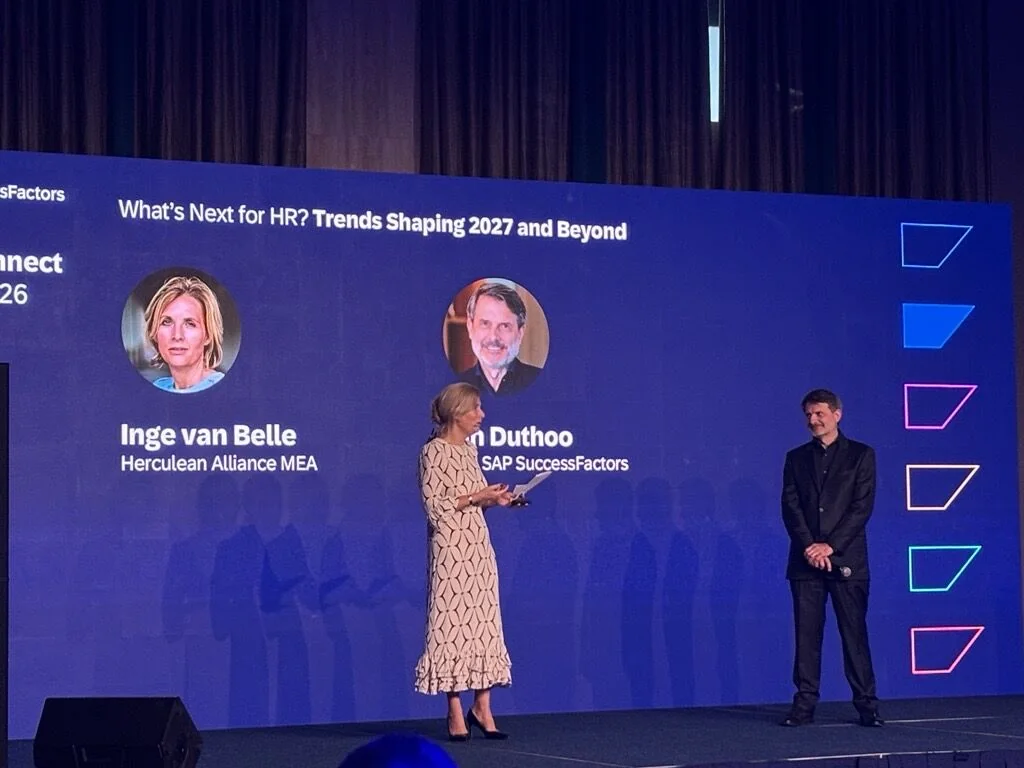
On Thursday 26 November, Inge Van Belle gave the main keynote at HR Connect UAE, SAP's morning for HR and HR IT leaders at the Taj Exotica Resort & Spa on The Palm in Dubai. The brief was a difficult one: what will the next years actually ask of HR? This is what she took on stage, and what came out of the fireside chat that followed.
The shift underneath everything else
In 2027, having AI will not set a company apart from anyone. Everybody has it, including the competitors and the intern who started last week. The moment a tool is everywhere, it stops being an advantage, and what counts instead is proof that it is paying off.
That proof is rare. Workday found that almost 40% of the time AI saves gets spent again on checking and correcting what it produced. KPMG found that 95% of large organisations have an AI strategy while only 8% report an established return on it.
So the divide of next year is not between the organisations using AI and the ones that are not. It runs between widespread use and measurable value, and HR is standing in the middle of it. Value comes from what an organisation does differently with the capacity AI frees up, which means redesigning how the work gets done. That is not an IT project.
The 4 trends
AI shifts from adoption to value. Having the tool is no longer the edge. Showing that it delivers is. Most organisations can report usage rates. Very few can show better performance, better quality or better decisions.
Human and AI collaboration becomes everyday work. Not people using a tool, but hybrid teams of humans and agents working side by side. The leaders who learn to frame the right problems for those teams will be far more productive than the rest, and somebody has to lead the mixed team. That is a people job.
AI is hollowing out entry-level work. The simple structured tasks go first, and they were the tasks that trained the next generation. The twist is what happens to the junior roles that remain: we increasingly expect people to walk in on day 1 doing work that used to take years to grow into.
HR moves closer to the board. Once people decisions and AI decisions are the same decision, the person who actually understands people belongs in the room where it is made.
Every one of these is a people question. None of them is simple, and that is exactly where the opportunity sits.
Why the CHRO should lead the AI transformation
In the fireside chat, Jan Duthoo, Chief Revenue Officer of SAP EMEA, asked why we put the CHRO, rather than the CIO, at the head of an AI transformation.
Because AI is not a technology rollout. It is a business transformation, and a business transformation without a cultural transformation is a utopia. You cannot change your systems, your operating model and your ways of working if the human interactions do not change with them. Changing how people work together is the CHRO's home ground.
The CIO can build the system. Somebody still has to lead the humans through it, and the CHRO is the only person whose entire job is people, at scale, with the business in mind. Inge put it this way on stage: the real job of HR is not to be the architect of processes and frameworks, it is to be the doctor of passion. Find where the energy is stuck, free it up, make the organisation genuinely want this.
The research agrees, bluntly. Deloitte found that adding an AI expert to a customer service team without changing the roles or the workflow raised productivity by 5%. Redesigning the workflow, the handoffs, the escalation paths and the training around the human and the machine raised it by 30%. Yet SHRM found that 52% of organisations do not involve HR in setting their AI strategy at all.
Where this leaves the function
The paradox of the AI age is that the more advanced the technology becomes, the more human leadership matters. Holding a culture together while everything underneath it changes is the hardest work in the building, and it is the part a machine will not do.
Inge closed with the line the room took away with them. Be good with numbers: bring the data, prove the value, come with evidence rather than opinions. Be better with people, and make every one of them a success story.
Inge Van Belle is co-founder of Herculean Alliance and the author of Employee Engagement. What Else? Her own write-up of the keynote is on her blog: In 2027, AI will not set anyone apart and Be good with numbers. Be better with people. The trends draw on AIHR's HR Trends 2027: Work, Redesigned.